
The Data Gap Crisis: Why Silent Pipeline Failures Hurt More Than You Think
Today, businesses depend heavily on sensor data for daily operations and customer experience. Whether it is cold-chain logistics, industrial automation, agriculture, or energy monitoring, companies make important decisions based on the data coming from sensors. But there is a growing issue that many organisations face: the data may appear normal even when the actual system is failing.
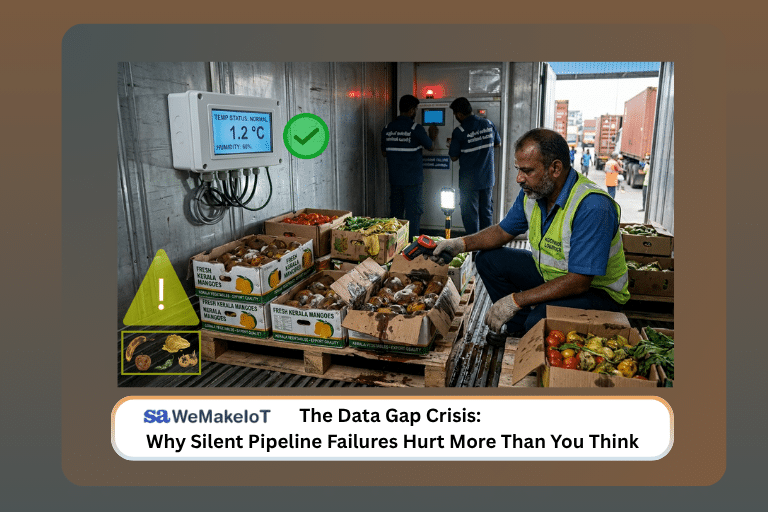
For example, a refrigerated truck may continue showing a “normal temperature” reading on the dashboard while the sensor itself has already become inaccurate or disconnected internally. The system looks healthy, but the products inside may already be damaged. These kinds of issues are difficult to identify immediately because the device is technically still online. This is what many companies are now experiencing as the “Data Gap Crisis.”
Understanding Silent Pipeline Failures
Most businesses assume that once a sensor is installed, the data will continue to remain accurate for years. In reality, sensors can slowly lose accuracy over time due to environmental conditions, wear and tear, poor calibration, power fluctuations, or communication issues.
This problem is often called sensor drift. The readings do not suddenly stop, they slowly become unreliable. Because the values still appear “reasonable,” the issue can go unnoticed for weeks or even months.
Another common challenge is maintenance. In large deployments with hundreds or thousands of sensors, manual calibration and health checks become expensive and difficult to manage. As a result, many devices continue operating beyond their recommended service cycle.
The real business risk is not just hardware failure, it is making decisions using incorrect data.
Moving Towards Sensor-as-a-Service (SaaS)
To solve these challenges, many companies are moving from traditional hardware ownership to a Sensor-as-a-Service (SaaS) model.
In the traditional model, businesses purchase the hardware upfront as a capital expense (CapEx). After installation, the responsibility for maintenance, calibration, replacements, connectivity issues, and monitoring usually falls on the customer’s internal team. Over time, this creates operational overhead and unexpected maintenance costs.
With the Sensor-as-a-Service model, the customer instead pays a predictable monthly or yearly operational cost (OpEx). The provider takes responsibility for keeping the entire sensing system healthy and reliable.
This changes the relationship completely. Since the service provider is responsible for delivering accurate and continuous data, they actively monitor the health of the devices. If a sensor starts behaving abnormally, loses calibration, shows unstable readings, or approaches end-of-life, the provider can identify the issue early and replace the device before it affects operations.
Many providers also use remote diagnostics and automated monitoring tools to continuously verify whether the sensor data reflects the real-world conditions accurately. Instead of only supplying hardware, they are effectively guaranteeing the reliability of the data itself through service commitments or Data Integrity Service Level Agreements (SLAs).
For businesses, this reduces downtime, lowers maintenance burden, improves reliability, and allows internal teams to focus more on operations and business growth rather than device management.
At WeMakeIoT, our IoT Solutions Development service is built around exactly this principle — end-to-end ownership so your team doesn’t have to manage the complexity.
Rebuilding Customer Trust Through Reliable Data
At the end of the day, customers do not think about sensors, calibration cycles, or firmware issues. They simply expect the information they receive to be accurate.
When businesses can consistently provide reliable data, they build stronger customer confidence and reduce operational surprises. Proactive maintenance, automated monitoring, and planned hardware refreshes help prevent silent failures before they become business problems.
The Bottom Line
In data-driven industries, inaccurate data can be just as dangerous as no data at all. Silent pipeline failures often remain unnoticed until they create financial loss, operational disruption, or customer dissatisfaction.
Sensor-as-a-Service is not only a different pricing model. It is a reliability-focused approach that helps businesses ensure continuous, accurate, and trustworthy data without carrying the full burden of hardware management.
Get in touch with us to know more.
Related WeMakeIoT Services