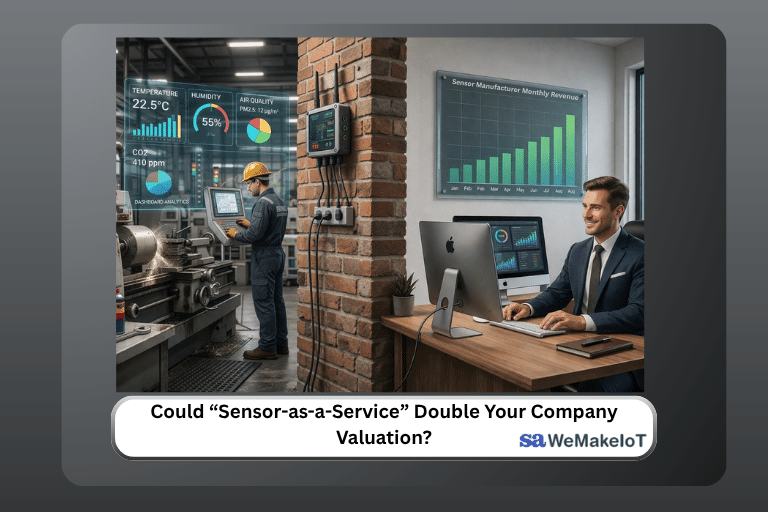
Could a “Sensor-as-a-Service” Model Double Your Company Valuation?
In the current global economic landscape, where efficiency and data-driven insights are the primary levers for growth, the traditional hardware-centric business model is increasingly viewed as a relic. For sensor manufacturers, the strategic challenge is no longer just building a more resilient sensor but transforming that hardware into a high-margin, recurring revenue engine via a sophisticated IoT Platform.
Transitioning to a Sensor-as-a-Service (SaaS) model, often termed as Sensing-as-a-Service, is a fundamental pivot. It allows a business to trade unpredictable hardware cycles for the high-multiple valuations typically reserved for pure software firms.
What is Sensor-as-a-Service?
Sensor-as-a-Service decouples physical hardware from the value it provides. Instead of selling a physical device as a one-off capital expenditure (CapEx), the company provides the outcomes generated by that device as an ongoing operational expense (OpEx).
The Role of the IoT Platform
The model is underpinned by a robust IoT Platform that acts as the connective tissue between the physical and digital worlds. It follows a four-tier architecture:
- Deployment: Smart sensors are installed, often with minimal upfront cost to the client.
- Ingestion: The IoT Platform securely manages the transmission of data via cellular or satellite protocols.
- Analysis: Edge computing, Rule Engines, or cloud-based AI processes raw telemetry into actionable intelligence.
- Visualisation: The customer accesses insights, not raw data, through a subscription-based dashboard.
The Valuation Multiplier: Building a Resilient Future
The shift to a service-based model is highly attractive to the investment community. While traditional manufacturing often faces cyclical market fluctuations, a service-oriented approach builds a more stable and scalable financial foundation.
- Predictable Growth: Transitioning to Annual Recurring Revenue (ARR) provides a clear, long-term financial forecast, which typically commands significantly higher market multiples than one-off sales.
- Deepened Client Partnerships: When you provide a continuous service, you stay closer to your customers’ needs. This ongoing engagement reduces churn and identifies new opportunities for innovation.
- Enhanced Intellectual Property: The data processed through your IoT Platform creates a unique “knowledge moat,” allowing you to refine your products and algorithms in ways that hardware-only competitors cannot match.
Diversified Revenue Streams
The shift to a service model unlocks several revenue streams that go far beyond the initial installation:
- Tiered Subscription Models: Revenue is generated through monthly or annual fees based on the level of data granularity, frequency of reporting, or the number of seats within the client organisation.
- Performance-Based Monetisation: This involves tying revenue directly to the results. For instance, the provider might take a percentage of the energy savings or maintenance costs identified and prevented by the sensors.
- API Access and Integration: Charging third-party integrators or partners to feed your unique sensor data into their own enterprise systems (ERPs or CRMs), creating an ecosystem around your data.
- Managed Lifecycle Services: Charging for the continuous optimisation of the fleet, including automated hardware refreshes, firmware updates, and proactive battery management.
Risks and Strategic Considerations
While the valuation upside is significant, leadership must manage the following challenges:
- Cash Flow Timing: Moving from CapEx to OpEx means the company carries the manufacturing costs upfront. This requires a robust capital strategy during the initial scaling phase.
- Security Sovereignty: Handling vast quantities of industrial or environmental data requires rigorous cybersecurity frameworks and compliance with international data standards.
- Operational Complexity: Maintaining a global fleet of sensors requires a “Hardware DevOps” mindset, managing battery lifecycles, signal interference, and remote updates at scale.
The evolution toward Sensor-as-a-Service is not about moving away from manufacturing; it is about amplifying its value. By leveraging an IoT Platform to stay connected to your products and your customers long after the initial deployment, you transform from a vendor into a strategic ally.
Get in touch with us to accelerate your journey into the Sensor-as-a-Service model.