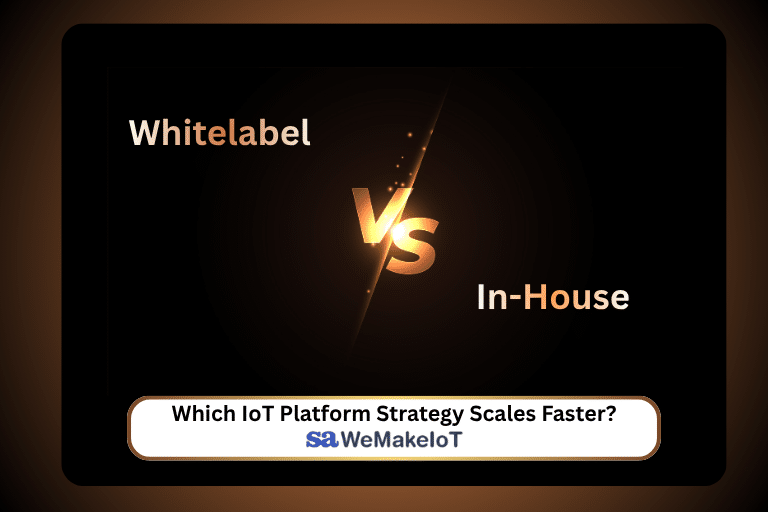
Whitelabel vs. In-House: Which IoT Platform Strategy Scales Faster?
As the industry moves toward 2026, the question for sensor manufacturers is no longer if they should offer an IoT Platform, but how they should build it. To secure a Recurring Payment model, you need a reliable IoT Platform where clients can interact with your data.
But as a hardware-centric company, should you build this IoT Platform internally or opt for a White label solution?
Simple Overview: White Label vs. In-House Development
- White label IoT Platform: This is a ready-to-use IoT Platform ecosystem built by a third-party provider. You license the technology, apply your own branding, and resell it to your customers. It allows you to offer a SaaS IoT Platform under your own name without writing a single line of code.
- In-House Development: This is the traditional approach of hiring an IoT Platform engineering team to build a proprietary platform from the ground up. You own every part of the source code, the server architecture, and the intellectual property.
The Comparison: Which One Is Worth the Investment?
Choosing the right strategy requires a look at initial costs, long-term ROI, and the speed at which you can transition to a Sensor as a Service provider.
1. Initial Investment and Overhead
- White Label: Requires minimal upfront capital. You typically pay a setup fee and a monthly subscription. It turns development into a variable expense you only pay as you scale or customise.
- In-House: Requires a massive financial injection. You aren’t just paying for code; you are paying for recruitment, high development charges, in-house support developers, etc. This creates a high fixed overhead regardless of how many sensors you sell.
2. Speed to Market & Opportunity Cost
- White Label: You can launch your branded IoT Platform in a matter of weeks. This allows you to immediately begin capturing Recurring Payment revenue from existing hardware clients.
- In-House: The development lifecycle for a stable IoT dashboard often takes 6 to 18 months. Every month spent in development is a month of lost subscription revenue and an “opportunity cost” that can often exceed the cost of the IoT Platform itself.
3. Maintenance and Long-Term Scaling
- White Label: The IoT platform providers handle security patches, server uptime, and API updates. Your focus remains on sensor innovation.
- In-House: You have total control. If you need a specific niche feature for a high-value client, you build it. The downside is that you are also responsible for 24/7 technical support and security.
Which Model Suits You Best?
Choose In-House Development if:
- You want total ownership of the IoT platform and the source code.
- You have the capital to sustain an IoT Platform development team for 3+ years.
Choose White Label if:
- You want to scale quickly and start earning Recurring Payment revenue now.
- Your primary focus is sales, sensor manufacturing, and client relationships.
- You want fewer expenses and operational risks.
- You want to try or experiment with the Sensor as a Service strategy without committing to a massive upfront development budget.
Transitioning to a Sensor as a Service model is the most effective way for manufacturers to protect their business against hardware commoditization. Whether you choose to build or buy, the goal remains the same. Stop selling hardware once, and start selling insights forever.
Whether you are looking to launch immediately with our customizable White label IoT Platform or require a development team for your next web app development, Contact Us today to start transforming your hardware into a recurring revenue stream.