
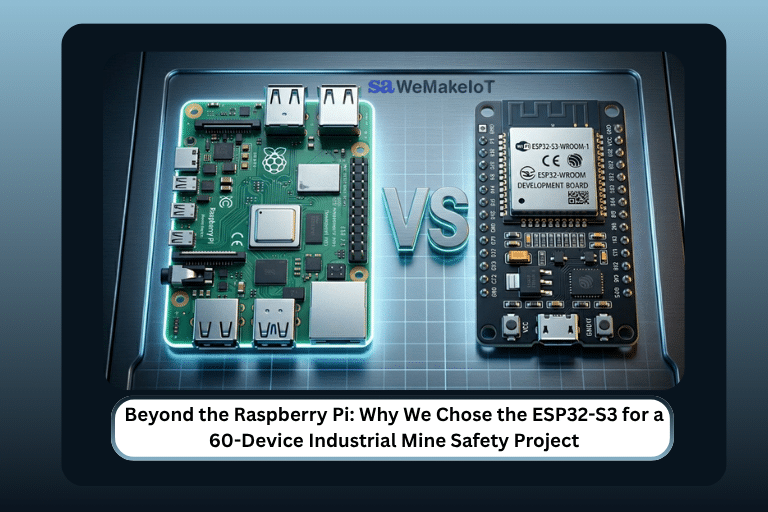
Why Did We Choose the ESP32-S3 over Raspberry Pi for a 60-Device Industrial Mine Safety Project?
When designing a connected industrial solution, the instinct for many developers is to reach for a Raspberry Pi. It’s powerful, it runs Linux, and it hosts web servers with ease. But what happens when your project scales to 60+ devices, needs to run on battery power for shifts at a time, and must operate in the harsh environment of a coal mine?
In our recent project – a Smart Mine Monitoring System – we faced exactly this dilemma. We needed to provide miners with real-time safety data via a locally hosted web dashboard, all without an internet connection.
The Challenge: Safety in the Silence
Coal mines are notoriously difficult environments for communication. Traditional Wi-Fi or Cellular signals don’t penetrate deep underground, and safety is paramount. Our solution required:
- LoRa Technology: To send alerts across long distances through rock and earth.
- Local Hosting: Each device needed to host its own web interface for local monitoring.
- Visual & Audio Alerts: A round display, an LED ring, and a buzzer for immediate danger warnings.
- Sensor Integration: Constant monitoring of temperature and toxic gases.
Why Raspberry Pi Wasn’t the Answer
Initially, a Raspberry Pi seemed like the easy route for the “local website” requirement. However, when we looked at the scale (60+ units), the math didn’t add up:
- Cost: Buying 60 Raspberry Pis and power management boards creates a massive financial burden.
- Power Hunger: A Raspberry Pi 4 draws roughly 2.8 Watts to 3 Watts just sitting idle, and can spike up to 5 Watts or more under load. When you add a display and constant sensor polling, it becomes a power hog. To keep a Pi running through an entire mine shift, the required battery pack would be too bulky and expensive for a portable safety device.
- Boot Times & Reliability: In a mine, if a device power-cycles, it needs to be “on” instantly. A Pi takes 30-60 seconds to boot a full OS.
The Breakthrough: Hosting on the ESP32-S3
We decided to push the limits of the ESP32-S3. While it is a microcontroller, not a full computer, it is surprisingly capable. Developing the locally hosted web app on the ESP32 was more challenging – we had to optimise the code for the chip’s memory limits rather than relying on a heavy web server.
However, once the first system was perfected, the benefits were undeniable. We achieved a lightweight, ultra-fast-booting device that could run for extended periods on a fraction of the battery size required by a Pi.
Head-to-Head: Raspberry Pi vs. ESP32-S3
To help you choose the right controller for your next deployment, here is how they stack up across key features:
1. Hardware Cost
- Raspberry Pi (SBC): High ($35 – $80+ per unit)
- ESP32-S3 (Microcontroller): Low ($4 – $10 per unit)
2. Idle Power Consumption
- Raspberry Pi (SBC): ~600 mA (~3.0 W) – Requires large batteries/active cooling
- ESP32-S3 (Microcontroller): ~25 mA (~0.08 W) – Ideal for battery/solar
3. Active / Peak Power Draw
- Raspberry Pi (SBC): ~1200 mA to 1500 mA (Up to 7.5 W) under heavy load
- ESP32-S3 (Microcontroller): ~90 mA to 340 mA (Max ~1.1 W) during active Wi-Fi transmission
4. Web Hosting Complexity
- Raspberry Pi (SBC): Easy (Standard Linux stacks like Nginx/Node)
- ESP32-S3 (Microcontroller): Harder (Requires optimized C++/MicroPython)
5. Boot Time
- Raspberry Pi (SBC): Slow (30 – 60 seconds)
- ESP32-S3 (Microcontroller): Instant (Milliseconds)
6. Environmental Durability
- Raspberry Pi (SBC): Sensitive (Relies on Raspberry Pi OS / SD cards can corrupt)
- ESP32-S3 (Microcontroller): Robust (No OS)
7. User Interface Development
- Raspberry Pi: Full Raspberry Pi OS, Custom UI Development, and Easy Development.
- ESP32-S3 (Microcontroller): Limited Resources, HTML files need to be compressed/used, significant manual effort and optimisation needed.
8. Best Used For
- Raspberry Pi (SBC): Heavy processing, AI, Desktop-like apps
- ESP32-S3 (Microcontroller): Dedicated industrial tasks, Sensors, IoT
The Verdict: Scale Demands Efficiency
While the development phase for the ESP32-S3 took more effort to get the web interface “just right,” the long-term ROI was massive. For a 60-device deployment, we saved thousands in hardware costs and provided a more reliable, longer-lasting safety tool for the workers underground.
In the world of IoT, “more power” isn’t always better. The best tool is the one that fits the environment, the budget, and the battery life.
Need help choosing the right hardware for your IoT project?
Our team specialises in ESP32-based IoT development and full IoT Solutions Development from prototype to production.